

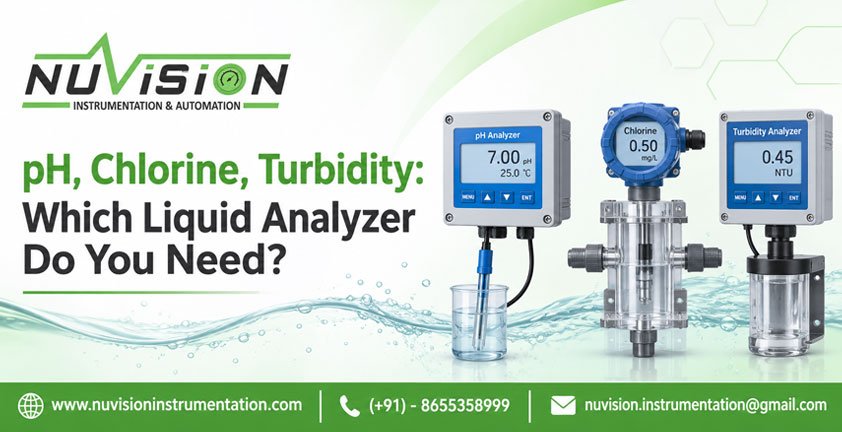
The right liquid analyzer depends on the problem you need to catch. Use a pH analyzer for acidity or alkalinity, a conductivity analyzer for dissolved salts, a chlorine analyzer for disinfection control, a turbidity analyzer for cloudiness and suspended solids, a dissolved oxygen analyzer for biological or corrosion control, and a hardness analyzer for scale prevention. Most plants need two or three of these working together.
Table of Content
What is a liquid analyzer?
A liquid analyzer is an online instrument that continuously measures the chemical or physical quality of a liquid inside a pipe, tank or sample line. It is made of a sensor that touches the liquid, a transmitter or controller that converts the signal into a reading, and usually a holder or fitting that mounts the sensor in the process.
Unlike a lab test, which gives you a number once a day or once a shift, an online analyzer gives a reading every few seconds. That reading can raise an alarm, drive a dosing pump, or feed your PLC or DCS so the process corrects itself before a batch is lost or a limit is crossed.
Start with the problem, not the sensor name
Most buying guides list sensors one by one. That is how a catalogue works, but it is not how a plant engineer thinks. Engineers usually walk in with a symptom. Use this problem-first map to find where to start:
| If your problem is… | Measure this | Analyzer type |
|---|---|---|
| Chemical dosing is unstable, product is off-spec | Acidity or alkalinity | pH analyzer |
| Water looks fine but scale or corrosion keeps appearing | Dissolved salts, hardness | Conductivity and hardness analyzer |
| Disinfection is failing or you are overdosing chlorine | Disinfectant residual | Chlorine analyzer |
| Water is cloudy, filters clog, compliance is at risk | Suspended particles | Turbidity analyzer |
| Corrosion in boilers or pipes, or poor biological treatment | Oxygen level | Dissolved oxygen analyzer |
| You need to know if a reaction or oxidation step is complete | Oxidising or reducing power | Redox (ORP) analyzer |
If you recognise yourself in more than one row, that is normal. A water treatment line, for example, often needs turbidity, chlorine and pH together, because each one affects how the others behave.
pH analyzer: when acidity decides your outcome
What it measures: how acidic or alkaline a liquid is, on a scale of 0 to 14.
Choose it when your process depends on neutralisation, chemical reaction control, effluent discharge limits or product consistency. Drinking water in India, for example, is expected to sit between 6.5 and 8.5 under IS 10500, and most effluent discharge norms also specify a pH band.
What to check before buying:
- Sensor material and junction type that suit your liquid, since fouling, high temperature and strong chemicals wear electrodes differently
- Temperature compensation, because pH changes with temperature
- How easily you can remove the sensor for cleaning and calibration
A practical note: pH electrodes are consumable. Plan for regular two-point calibration with buffer solutions and replace the electrode when response becomes slow. A drifting pH reading is one of the most common reasons a dosing system misbehaves.
Explore our pH sensors for process applications.
Need combination electrodes or portable pH, redox and conductivity meters? See the full pH electrode and meter range.
Chlorine analyzer: disinfect enough, not too much
What it measures: the residual disinfectant in water. Depending on the sensor, this can be free chlorine, total chlorine, chlorine dioxide, ozone, hydrogen peroxide or peracetic acid.
Choose it when you disinfect drinking water, treat swimming pool or cooling water, or clean food and beverage lines. Too little disinfectant is a safety risk. Too much wastes chemicals, causes taste and odour complaints and can damage equipment.
What to check before buying:
- Whether you need free or total chlorine, or a different disinfectant altogether
- pH dependence. The disinfecting power of free chlorine changes strongly with pH, so many installations measure pH alongside chlorine and compensate for it
- Sample flow requirements, since many chlorine sensors need a steady flow past the sensor
See our chlorine sensors.
For ranges and specifications, including total chlorine, chlorine dioxide and ozone, see our chlorine sensor technical page.
Turbidity analyzer: seeing what the eye cannot
What it measures: how cloudy a liquid is because of suspended particles, reported in NTU (Nephelometric Turbidity Units). The instrument shines light into the sample and measures how much is scattered by particles.
Choose it when you run filtration, clarification or any process where particles signal a problem. A rising turbidity reading is often the first warning that a filter is breaking through. Turbidity also matters for disinfection, because particles can shield microorganisms from chlorine. Under IS 10500, the acceptable limit for drinking water turbidity is 1 NTU.
What to check before buying:
- Measuring range, because drinking water needs a very low range while wastewater needs a much higher one
- Built-in cleaning or wiper options for dirty applications
- Bubble handling, since air bubbles read as particles and cause false spikes
Turbidity measurement is part of our liquid analysis instruments range.
Product details are also listed on our turbidity sensor page.
Conductivity analyzer: the quickest read on dissolved salts
What it measures: how well the liquid conducts electricity, which tracks the amount of dissolved ions.
Choose it when you monitor boiler feedwater, cooling towers, demineralised water, reverse osmosis performance, CIP (clean-in-place) cycles or chemical concentration.
Contacting or inductive? Contacting sensors work well in clean, low-conductivity water. Inductive (toroidal) sensors suit dirty, aggressive or high-conductivity liquids because no metal electrode touches the process.
See our conductivity sensors.
For dirty or aggressive liquids, see the inductive conductivity sensors.
Dissolved oxygen, hardness and redox: the specialists
Dissolved oxygen (DO) shows how much oxygen is in the water. Wastewater plants use it to control aeration, and boiler plants use it to catch corrosion risk. Fermentation processes in biotech also rely on it.
Hardness reflects calcium and magnesium in water. Monitoring it after a softener tells you when the resin is exhausted, which protects boilers and heat exchangers from scale. See our hardness sensors.
Redox (ORP) measures oxidising or reducing power in millivolts. It is widely used to confirm disinfection strength and to track oxidation or reduction steps. See our redox and oxygen sensors.
For dissolved oxygen specifications, see our dissolved oxygen sensor page.
Five questions to ask before you buy any liquid analyzer
- What decision will this reading drive? An alarm, a dosing loop and a compliance record each need different accuracy and response times.
- What is in the liquid? Solids, oils, high temperature or aggressive chemicals decide the sensor material and the need for cleaning.
- Where will it be mounted? In-line, in a tank, or on a sample line. A retractable holder lets you pull the sensor out for service without stopping the process.
- How will the signal be used? Check for 4-20 mA output, relay outputs and digital communication so the analyzer connects cleanly to your PLC, DCS or recorder.
- Who will maintain it? Calibration, cleaning and spare parts are part of the real cost of ownership, not an afterthought.
Once the reading is available, you can connect it to a PLC, a DCS or a data logger and HMI. If you want measurement and control packaged together, see our water analysis station and pH control station solutions.
Common mistakes that waste money
- Buying the sensor but not the sample conditioning. A good sensor in a poor sample line still gives bad data.
- Ignoring calibration. Every analyzer drifts. A calibration schedule matters as much as the purchase.
- Measuring one parameter when two are linked. Chlorine without pH, or turbidity without a flow check, can mislead you.
- Choosing on price alone. The cheapest sensor that fouls every week costs more than a suitable one that runs for months.
If you need the sample line built around your analyzer, see our analyzer panels and sampling panels.
Which liquid analyzer for which industry?
- Water and wastewater: turbidity, chlorine, pH, conductivity and dissolved oxygen. See our water and wastewater solutions.
- Pharmaceuticals: conductivity and pH for purified water and process control, with data you can log and audit. See our pharmaceutical industry solutions.
- Food and beverage: pH, conductivity for CIP, and disinfectant monitoring. See our food and beverage solutions.
- Power, chemical and fertiliser plants: conductivity, hardness, dissolved oxygen and pH for boiler and cooling water.
More industry-wise instrument guidance is available for water and wastewater, pharmaceuticals and biotechnology, food and beverage and chemical and fertilizer plants.
How Nuvision Instrumentation can help
Nuvision Instrumentation is a Mumbai-based supplier and exporter of process measurement and control instruments. We supply pH and redox electrodes, conductivity sensors, chlorine, hardness and dissolved oxygen sensors, turbidity measurement, transmitters, controllers and process fittings, along with products from brands such as Jumo, ABB, Emerson, Honeywell and Siemens.
Nuvision Instrumentation is an ISO 9001:2015 certified company, and you can read more about our manufacturing and quality approach on our company website.
Beyond supply, our team helps with selection, installation and calibration support, so the analyzer you choose fits your process on day one.
Brand-wise product pages: Jumo, ABB, Emerson, Honeywell and Siemens.
Not sure which analyzer fits your application? Share your liquid, range and mounting details and our team will recommend a suitable option. Get a quote or call +91-8655358999.
What is the difference between a liquid analyzer and a sensor?
The sensor is the part that touches the liquid and detects the property. The liquid analyzer is the complete measuring system: sensor, transmitter or controller, and mounting hardware.
Which liquid analyzer is best for drinking water treatment?
Most treatment plants use turbidity, free chlorine and pH analyzers together. Conductivity is often added for source water or reverse osmosis monitoring.
How often should a pH or chlorine analyzer be calibrated?
It depends on the application and how much the sensor fouls. Dirty or critical processes may need weekly checks, while clean water applications may run longer. Follow the manufacturer’s guidance and your own drift records.
Can a liquid analyzer connect to my PLC or DCS?
Yes. Most transmitters provide a 4-20 mA signal, relay outputs or digital communication, so readings can feed your PLC, DCS or recorder directly.